The product of a collaboration between LEGO and celebrated architectural artist (and LEGO Certified Professional) Adam Reed Tucker, whose educational company, BrickStructures, Inc., specializes in the design and execution of scale replicas of architectural masterpieces in the ubiquitous plastic bricks. Or rather, not replicas. Tucker makes this point on the BrickStructures web site: “I first and foremost do not view my models as literal replicas, but rather artistic interpretations that capture the essence of their sculptural form.” Furthering his educational mission, Tucker’s ‘artistic interpretations’ are currently the centerpiece of an exhibition at Chicago’s Museum of Science & Industry. “With products such as the line of souvenir sets and educational events, we wish to promote an awareness of the fascinating worlds of architecture, engineering and construction in a new and unexpected way.” Tucker states. In the newly released Frank Lloyd Wright licensed series, as in the entire LEGO Architecture program, Tucker’s artistry is equally evident in the individual designs and in the overall concept, which puts to shame anything that’s come out of Billund recently. They are simple, honest and to the heart of what has made LEGO a mainstay of Twentieth-Century childhood.
Lego Architecture Landmark Series
Sears Tower
✍ 2008: Adam Reed Tucker, Owings & Merrill Skidmore, Bruce Graham & Fazlur Khan
The first in the LEGO Architecture series, this striking black-and-white replica of the famous Sears Tower in Chicago measures 9 inches (228 mm) tall.
John Hancock Center
✍ 2008: Adam Reed Tucker, Owings & Merrill Skidmore, Bruce Graham & Fazlur Khan
Another Chicago landmark, this model of the John Hancock Center measures 7.5 inches (192 mm) tall.
Empire State Building
✍ 2009: Adam Reed Tucker & Lamb & Harmon Shreve
The Empire State Building, third in the LEGO Architecture Landmark series, proudly standing 7.4 inches (188 mm) tall.
Space Needle ✍ 2009: Adam Reed Tucker, Edward Carlson, John Graham & Victor Steinbrueck
This futuristic tower, Seattle’s famous Space Needle created for the 1962 World’s Fair, is the fourth in the LEGO Architecture Landmark series.
Each set: $29.95
Lego Architecture Frank Lloyd Wright Series
Solomon R. Guggenheim Museum
✍ 2009: Adam Reed Tucker & Frank Lloyd Wright
2009 marks the 50th anniversary of New York City’s best-known museum, the Solomon R. Guggenheim, designed by Frank Lloyd Wright. The Guggenheim set stands 4 inches (102 mm) tall and includes a booklet describing the history and construction of the classic 5th Avenue landmark.
$62.95
Fallingwater
✍ 2009: Adam Reed Tucker & Frank Lloyd Wright
Designed by Frank Lloyd Wright in 1934, Fallingwater is the most famous residential architectural design in the world. The assembled model stands 10 inches (256 mm) wide and includes a booklet with facts about the building, its construction and its history.
$149.95
_________________________________
To purchase any of the products or titles mentioned here, please visit our downtown Toronto location, call us toll-free at 1-800-56-swipe or e-mail us at: info@swipe.com.
11 am to 6 pm: Thursday to Saturday, November 19th to 21st
Okay, so we don’t really have a sidewalk so, yes, technically, it’s more of a really long hallway sale, but 50% off on great design is still 50% off and you won’t get rained on, have leaves blowing around your head, or diesel exhaust to deal with just great design at great prices, at a building you love having an excuse to visit.
Bring a print of this page and, in addition to 50% off on selected merchandise, you’ll get 15% off all regularly priced gift items and 10% off all regularly priced books!
In the late 1960s and earily 1970s Bruno Munari and Enzo Mari produced a series of children’s books and products for Italian manufacturer Danese, who otherwise specialized in fancy desk accessories and stylish ashtrays (a rather Italian product mix). Despite this association, the two designers are reputed to have rather contrasting personalities.
Bruno Munari is one of the most universally beloved figures in Italian art and design. Having designed and illustrated children’s books for decades, Munari began, in the 1960, to travel the country giving workshops on art and creative thinking to young children and their teachers. While none of us at Swipe ever met Munari, several of our Italian customers of a certain age relate fond grammar-school memories of “Uncle Bruno”.
With Mari we do have some direct experience. In 1999, after having spent a day being shown around Toronto by a Design Exchange staffer, the diminutive Mari marching up to the counter at Swipe and announced unceremoniously: “I used to think Canada was the country of dreams, now I know it is the country of shit.” A second Mari story come by way of a customer who, while attending a party at the flagship Alessi shop on Corso Matteotti in Milan, noticed a man sitting all alone in a corner. When he asked his host who the sad looking gentleman was, he was told: “Ahh, that is Mari. Nobody likes Mari.”
What is most astounding about Mari’s reputation as a world-class grump is that he is, in fact, responsible for some of the most lyrical, joyful and empathetic pedagogical products ever designed. His 16 Animali and 16 Pesci puzzles, designed in 1957 and produced by Danese throughout the 1970s, are wondrous objects, equally delightful to any three-year-old as to the most critical aficionado of industrial design. Anyhow, perhaps Mari’s frankness is exactly what the design world needs today. At a recent talk hosted by the Italian Cultural Institute in San Francisco, Mari stated flatly: “Now, people frequently want to buy stupid things, but good design is not a copy of what people want.” Damn.
Nella Notte Buia / In the Darkness of the Night
✍ 1956: Bruno Munari
Arguably Munari’s most famous children’s book, In the Darkness of the Night is a poignant and touching voyage through darkness. First published in 1956, the book has become a landmark in children’s publishing for its tactile and interactive qualities. (1996: Corraini Editore; ISBN 9788875700799)
$ 48.95
Bruno Munari’s ABC
✍ 1960: Bruno Munari
Munari’s ABC was originally published exclusively for the American book market in 1960, but its success led to numerous reprints in multiple languages, including his native Italian. Beautifully illustrated in Munari’s iconic style, ABC plays with whimsical combinations of text and image to create a playful introduction to the alphabet. (2003: Chronicle Books; ISBN 0811854639)
$ 25.95
The Circus in the Mist
✍ 1968: Bruno Munari
As with In the Darkness of the Night, the elaborately produced and beautifully illustrated The Circus in the Mist is a wonderful book for children and adults alike. With a range of paper stocks, and the creative use and vellum and die-cuts, Munari captures the feeling of traversing Milan’s characteristic fog only to arrive at a circus dress rehearsal. (1996: Corraini Editore; ISBN 9788887942972)
$ 43.95
Adapted from Munari’s famed Playing with Art workshops, this wonderful series for older children playfully explores the relationship between perception and visual representation. In Munari’s view, careful observation leads to liberated self-expression and actually connects the young artist to the essential nature of the subject. Make art, not pictures!
Drawing a Tree
✍ 1978: Bruno Munari
“When drawing a tree always remember that every branch is more slender than the one that came before. Also note that the trunk splits into two branches, then those branches are split into two, then those two, and so on, and so on, until you have a full tree, be it straight, squiggly, curved up, curved down, or bent sideways by the wind.” – BM (2000: Edizioni Corraini; ISBN 888794276)
Drawing the Sun
✍ 1980: Bruno Munari
“When drawing the sun, try to have on hand coloured paper, chalk, felt-tip markers, crayons, pencils, ballpoint pens. Also remember that sunset and dawn are the back and front of the same phenomenon: when you are looking at the sunset, the people over there are looking at the dawn.” – BM (2000: Edizioni Corraini; ISBN 8887942773)
$19.95 each
Più e Mino / Plus and Minus
✍ 1970: Bruno Munari & Giovanni Belgrano
A unique visual game for children, Plus and Minus consists of 72 images printed on opaque and transparent cards, which can be superimposed to create landscapes, vignettes and narrative scenes.
As can be expected of Munari’s games, there are no rules and the game is only limited by the child’s imagination. This new edition of Plus Minus has been carefully reissued by Corraini, remaining completely faithful to the 1970 original. (2008: Edizioni Corraini; ISBN 8033532910020)
$ 74.95
Il Gioco delle Favole / The Fable Game
✍ 1965: Enzo Mari
The Fable Game is among Mari’s most beloved projects and is one of the high points in the history of design for children. Similar to the Eames’ House of Cards, The Fable Game consists of interlocking cards printed with characters from Aesop and La Fontaine, intended to encourage children to develop narratives based on the ‘intersections’ of the cards. Each new card combination brings together different characters and suggest a new story. (2004: Edizioni Corraini; ISBN 888794296x)
$ 38.95
Drawing Cards 1: On Faces 2: A Train-Load Of… 3: Landscapes 4: Dreams and Other Things 5: Subjects and Sequences
✍ 1978: Enzo Mari
Another extraordinary concept piece from Mari, Drawing Cards anticipated Taro Gomi’s Doodles series by three decades. Each cardstock folder contains five long strips of thick drawing paper partially printed with images or graphic elements intended to provide a point of departure for young artists who would prefer to draw rather than simply colour. (2008: Corraini Editore; ISBNs 9788886250672; 9788886250665; 9788886250696; 9788886250702; 9788886250689)
$14.95 each set
Il Posto dei Giochi / The Place of Games
✍ 1967: Enzo Mari
Perhaps Mari’s key insight was his recognition that children are best left to imagine for themselves. With his die-cut cardboard play structure Il Posto dei Giochi, or The Place of Games, Mari provides a subtle suggestion of fantastic environments, leaving the child’s imagination to fill in the rest. Unfortunately, Il Posto dei Giochi is produced in Italy in such small quantities that it is priced more as a design object than as a child’s toy.
$ 149.95
_________________________________
To purchase any of the products or titles mentioned here, please visit our downtown Toronto location, call us toll-free at 1-800-56-swipe or e-mail us at: info@swipe.com.
Through a combination of good design and perceptive market-assessment, PlanToys of Thailand has, over 28 years, carved a unique niche in the North American and European toy market. The company has demonstrated an understanding of the Western parent that Mattel™ and the rest of the Toys-R-Us™ crowd seem incapable of achieving. For instance, instead of having to wrestle toxic Disney™ licensed action figures from the hands of disappointed toddlers, parents might prefer toys that are both safe and manufactured in a sustainable manner. With a string of ISO certifications for product safety and socially responsible management, Plan is a model for a more ethical relationship between Western consumers and manufacturers in the developing world.
PlanToys Mini Garbage / Recycling Truck
✍ 2009: Vitool Viraponsavan & Plan Creations
Part of PlanToys new eco-themed line of toys that help kids learn how to live in harmony with the environment, this sturdy truck will delight any toddler while offering parents an opportunity to introduce the concepts of waste reduction and recycling.
$24.95
PlanToys Eco Green Dollhouse, with Furniture
✍ 2009: Vitool Viraponsavan & Plan Creations
The most elaborate (and costly) item in the PlanToys eco line, this full-size dollhouse features a (pretend) wind turbine and solar cell panel, a rain barrel, a green facade and roof, and a shade canopy. There is even an adorable little set of recycle bins and all furniture is included.
$249.95
All PlanToys are made from reclaimed rubber wood with water or soy-based finishes in ISO 9001, ISO 14001, OHSAS 18001 and SA 8000 certified, locally-owned factories in Thailand.
_________________________________
To purchase any of the products or titles mentioned here, please visit our downtown Toronto location, call us toll-free at 1-800-56-swipe or e-mail us at: info@swipe.com.
Girder and Panel Building Sets
✍ 1956: Austin Kelk & Peter Kelk
In 1956 Toronto toy manufacturer Peter-Austin Manufacturing produced a novel toy building system consisting of interlocking polystyrene girders and thin vacuformed panels. Marketed in Canada as the Trans Canada Highway Bridge Set and later, with the addition of architectural wall panels, as Pam ‘n Andy Structural Building Sets, the system was licensed by Kenner Products of Cincinnati in 1957 and released in the United States as Grider and Panel.
This wonderful Canadian design, the first architectural toy to emulate Twentieth-Century curtain wall construction techniques, remained in production with Kenner until 1980. However, given its Canadian origins, it is not surprising that the product continued to be manufactured in Canada long after that. In fact, as late as 1994, we carried the line at Swipe (at that time manufactured by Irwin Toys of Toronto) although it did disappear altogether shortly thereafter.
In 2005 engineers Carol and Peter Flack founded Bridge Street Toys near Boston for the sole purpose of reviving Girder and Panel and the more elaborate “Hydrodynamic” pump, tank and valve building system. The line has been gratifyingly well received by a new generation of parents and educators, winning Parent’s Choice, NAPPA, and Dr. Toy awards. We offer a selection of all systems, though as these are bulky items, shipping to Canada makes them unfortunately expensive. Also, for anyone nostalgic about a particular set they had as a child, there is a comprehensive collector’s site with pictures of virtually every historic model.
Girder and Panel Tower Set: $79.95
Girder and Panel Plaza Set: $129.95
Bridge and Turnpike Set: $79.95
Hydrodynamic Deluxe Set: $149.95
_________________________________
To purchase any of the products or titles mentioned here, please visit our downtown Toronto location, call us toll-free at 1-800-56-swipe or e-mail us at: info@swipe.com.
For Swipe’s annual Summer Amusement, we celebrate the 60th anniversary of a consistently successful brand-driven company. Throughout the 50’s and 60’s Wham-O™ had an unbelievable string of brand successes: first Frisbee,™ then Hula Hoop,™ and finally SuperBall™. Wham-O was also early to embrace television as a promotional medium and, with the help of a series of zany commercials, managed to maintain momentum through the 70’s and 80’s with products like Hacky Sack™ and Slip’N Slide™.
Wham-O Hula-Hoop
✍ 1958: Arthur K. (Spud) Melin & Richard Knerr
What set Wham-O apart from other post-war toy startups was their innovative use of plastics and pioneering use of modern marketing methods. In 1957 an Australian company was offering wood exercise hoops in American retail stores. The item attracted the attention of Richard Knerr and Arthur Melin, of Wham-O, who started manufacturing hoops out of Martex in a variety of bright colors. For months prior to Hula-Hoop’s release, Knerr and Melin promoted their product on Southern California playgrounds, where they would hold a demonstration and give a free hoop to the most co-ordinated boy and girl at each demonstration (rather cynically, they gave hoops to the most attractive boy and girl as well). When the product was finally launched in 1958 twenty million were sold for $1.98 in the first six months alone. Genuine Wham-O Hula-Hoops are still manufactured in Emeryville, Claifornia.
Original Wham-O Hula-Hoop in three sizes, each: $9.95
Frisbee started life as a college pie-plate toss game (the name Frisbie sic. originates wtih a Connecticut bakery) which was developed into a patented product, the Pluto Platter by W. F. Morrison in 1955. Morrison’s collaboration with Wham-O began in 1957 with co-founder Richard Knerr quickly renaming the product Frisbee™ base on the colloquial name for the earlier pie plate game.
Wham-O Reflyer Frisbee
✍ 1955 (2009): Walter Frederick Morrison & Richard Knerr
Newly released for 2009, this 100% recycled polyethylene (60% post-consumer) version of the classic 110 g Fastback model is manufactured by Wham-O in their plant in Emeryville, Claifornia.
Original Wham-O Pluto Platter Glow-in-the-Dark Frisbee: $10.95
Original Wham-O Classic Frisbee: $3.99
Wham-O Reflyer Recycled Frisbee: $10.95
Wham-O SuperBall
✍ 1963: Norm Stingly & Richard Knerr
SuperBall was created as a collaboration between Wham-O and chemist Norm Stingly in 1963. The product is still made from Stingly’s hard synthetic black rubber, dubbed Zectro™ in Wham-O promotional speak, and, while there are prettier high-bounce balls on the market, nothing bounces higher.
Original Wham-O SuperBall: $1.99
_________________________________
To purchase any of the products or titles mentioned here, please visit our downtown Toronto location, call us toll-free at 1-800-56-swipe or e-mail us at:info@swipe.com.
Everyone loves Maira Kalman. She’s the cool aunt in the city that teenage kids run away to when they decide that their parents are hopelessly square. She’s embodies the civilized, thoughtful and sentimental qualities particular to New York City. You just want to take her to coffee and never come back. Conference organizers know this.
Maira was the M in M&Co and, while it is difficult to define each individual’s contribution to the output of the firm based on design credits alone, her illustration and inspiration crop up again and again throughout the M&Co and Colors years. With the death of husband and professional partner, Tibor, from non-Hodgkins lymphoma in 1999, Maira has simultaneously kept his work in the public eye and established herself as a beloved New York cultural icon and, in diverse media, one of the most respected artists working in America today.
Grand Central Station Mural: 1999
The breadth of Kalman’s interests and talents is awesome, ranging from brilliant children’s books, covers for the New Yorker, theatrical set designs, and a mural in Grand Central Station, to an entirely unpredictable bestseller in the form of an illustrated edition of Strunk and White’sElements of Style, and a newly launched New York Times illustrated blog, And the Pursuit of Happiness, following on the success of her earlier blog, The Principles of Uncertainty, published as a highly acclaimed book in 2007.
What Pete Ate from A-Z
Smartypants (Pete In School)
✍ 2003: Maira Kalman
Typical of Kalman’s children’s books, the Pete series is so universal and yet so intensely personal that it’s hard not to feel like you’ve lived next door to Pete and the gang for years. What Pete Ate ranks as one of the most original and delightful alphabet books ever written and Smartypants (Pete in School) captures a child’s view of school as intensely exciting while being fraught with potential social disaster. (2003: Puffin Books; ISBN 978039923362351699 & 2003: Putnam Juvenile; ISBN 0399234780)
I was out walking the dear dog (who is a sweet meal ticket – two books about him, one New Yorker cover and a back page) and I saw 500 things that made me want to make art. – MK
Fireboat: The Heroic Adventures of John J. Harvey
✍ 2005: Maira Kalman
Among the most astonishing and heartbreaking children’s books ever written. An extraordinary tale of the heroism of ordinary people and the potential for seemingly trivial efforts and acts of kindness to be important beyond reckoning. We won’t even try to summarize here. (2005: Puffin Books; ISBN 0399239537)
Next Stop Grand Central
✍ 2001: Maira Kalman
Grand Central is the functional heart of the greatest city of the Twentieth-Century. A wonder made all the more wonderful because it is so much more than a wonder. Here Kalman offers a passionate celebration of “the busiest, fastest, biggest place there is.” (2001: Puffin Books; ISBN 069811888x)
What Pete Ate from A-Z: $20.95
Smartypants (Pete In School): $23.95
Fireboat: The Heroic Adventures of John J. Harvey: $25.50
Next Stop Grand Central (paper only): $9.99
Elements of Style
✍ 1959 (2005): William Strunk, E. B. White & Maira Kalman
This classic manual has conveyed the principles of plain English style to millions of readers. So what would possess an artist to illustrate the work and then spend several years in an effort to convince first, the original publisher and later, the authors’ estates to allow its publication? And why is the result so bizarrely engaging? (2005: Penguin Books; ISBN 1594200696)
Principles of Uncertainty
✍ 2007: Maira Kalman
Principles originally ran from May of 2006 to April of 2007 as an illustrated blog on the New York Times Op-Extra page. Like peeking into your favourite artist’s personal sketchbook, this sequence of thematic visual studies defies easy classification. It is a sort of stream-of-consciousness, existential meditation on life and death, love and loss. (2007: Penguin Press; ISBN 9781594201349)
Elements of Style: $34.95
Principles of Uncertainty: $35.50
_________________________________
To purchase any of the products or titles mentioned here, please visit our downtown Toronto location, call us toll-free at 1-800-56-swipe or e-mail us at: info@swipe.com.
Bob Gill is one of the most influential figures in post-war graphic design and has the kind of biography that could easily be reimagined as a sitcom. Born in Brooklyn in 1931, Gill put himself through art school playing piano in the Catskills. In 1962, in Austin Powers’ London, he co-founded Fletcher / Forbes / Gill which today is known as Pentagram; in ‘67 he designed the first Beatles album cover for Apple Records; in ‘75 he directed a hardcore porno (Double Exposure of Holly) in New York; in ‘79 he created Beatlemania for Broadway (1006 performances); and in ‘81 he published one of the best-selling graphic design books of all time, Forget all the rules you ever learned about graphic design. Including the ones in this book. (unfortunately long out-of-print). And somewhere in between he created wonderful, whimsical children’s books, alone and in collaboration with Alastair Reid, the renowned translator of Borges and Neruda.
A Balloon for a Blunderbuss
✍ 1961: Bob Gill & Alastair Reid
Gill’s most enduring children’s book, the illustrations for this classic ‘trade-up’ scenario are bold and exciting and the concept evokes perfectly a kid’s train of thought. (2008: Phaidon Press; ISBN 9780714848730)
An odd example of life imitating art is the widely publicized story of Kyle MacDonald who, through a series of internet trades, began with paperclip and ended up with a house. –David
What Colour is Your World?
✍ 1962: Bob Gill
How we see the world around us has a lot to do with the assumptions we bring to perception. Here Gill asks children to consider taking an artist’s view of colour as more of a creative choice than an immutable attribute. (2008: Phaidon Press; ISBN 9780714848501)
I Keep Changing
✍ 1971: Bob Gill & Alastair Reid
Are you brave or afraid, slow or fast, ravenous or full? That all depends on when you’re being asked. It is thanks to Edizioni Corraini in Mantua, Italy that this Gill / Reid classic is available, so this edition is dual language, English and Italian. (2008: Edizioni Corraini; ISBN 9788875701628)
Balloon for a Blunderbuss: $14.95
What Colour is Your World?: $14.95
I Keep Changing: $32.95
_________________________________
To purchase any of the products or titles mentioned here, please visit our downtown Toronto location, call us toll-free at 1-800-56-swipe or e-mail us at: info@swipe.com.
Aquarellum is a simplified wax-resist painting concept for children – a sort of freeform watercolour paint-by-numbers where the child gets to choose the colours. Each Aquarellum set contains a set of primary colour liquid watercolour paints, a sturdy mixing tray and chart, a quality brush and four resist-printed cards. Each of these components is of surprisingly high quality. The process is challenging enough for a 12 year old, yet even a (well-supervised) three-year-old will achieve a very exciting result.
My three-year-old is addicted to these kits. She loves the process, has become a whiz with a paintbrush, and is always proud of the finished product. So, what’s the problem? Naturally, it’s the price. Made in France, these sets cost $24.95 and a younger child can go through each of the four cards in fifteen minutes. Makes a great Grandparent gift but, if you’re paying for it, save it for a special day when making something beautiful would really lift your child’s spirits. – David
To purchase any of the products or titles mentioned here, please visit our downtown Toronto location, call us toll-free at 1-800-56-swipe or e-mail us at: info@swipe.com.
The recent reissue of several classic children’s books by notable graphic designers ties together a number of threads in contemporary consumer culture. It speaks to a level public awareness and respect for design not seen, perhaps, since these books were originally published. It also demonstrates the power of various internet forums to bring forgotten or subcultural products to wider audiences. In this case e-bay, abebooks, and a variety of blogs conspired to raise awareness of several long out-of-print children’s titles by the likes of Paul Rand, Bob Gill, Bruno Munari and Tomi Ungerer. Finally, it highlights the expectation of parents that products for their children harmonize with the aesthetic standards they set for the products they buy for themselves.
Of the four children’s books on which Paul and Ann Rand’s collaborated, two were reprinted by Chronicle Books of San Francisco in 2006 and now a third, I Know a Lot of Things, will be released this month. As one might expect, Paul Rand’s graphics are masterful, however Ann Rand’s texts are a delightful surprise, full of whimsical ideas and pleasantly fractured poetics.
I Know a Lot of Things
✍ 1956: Paul & Ann Rand
The Rands’ first children’s book created for pioneering Harcourt Brace editor Margaret McEldery in 1956. Similar in concept to Ruth Krauss’ astounding Open House for Butterflys, Rand views consequential knowledge from a child’s perspective: “I know when I look in the mirror, what I see is me”. Winner of an AIGA Best Books award in 1957. (2009: Chronicle Books; ISBN 9780811866156)
Little 1
✍ 1962: Paul & Ann Rand
Ann Rand at her idiosyncratic best, Little 1 is simultaneously a number book and a story of alienation and friendship sure to resonate with kindergarden-aged children beginning to make their way in a larger social context. (2006: Chronicle Books; ISBN 0811850048)
Sparkle and Spin: A Book About Words
✍ 1957: Paul & Ann Rand
Again, a visually stunning Paul Rand design, in this case paired with Ann Rand’s engaging text exploring the rhythm and nuance of spoken language. (2006: Chronicle Books; ISBN 081185003x)
I Know a Lot of Things: $21.95
Little 1: $20.95
Sparkle and Spin: A Book About Words: $20.95
_________________________________
To purchase any of the products or titles mentioned here, please visit our downtown Toronto location, call us toll-free at 1-800-56-swipe or e-mail us at: info@swipe.com.
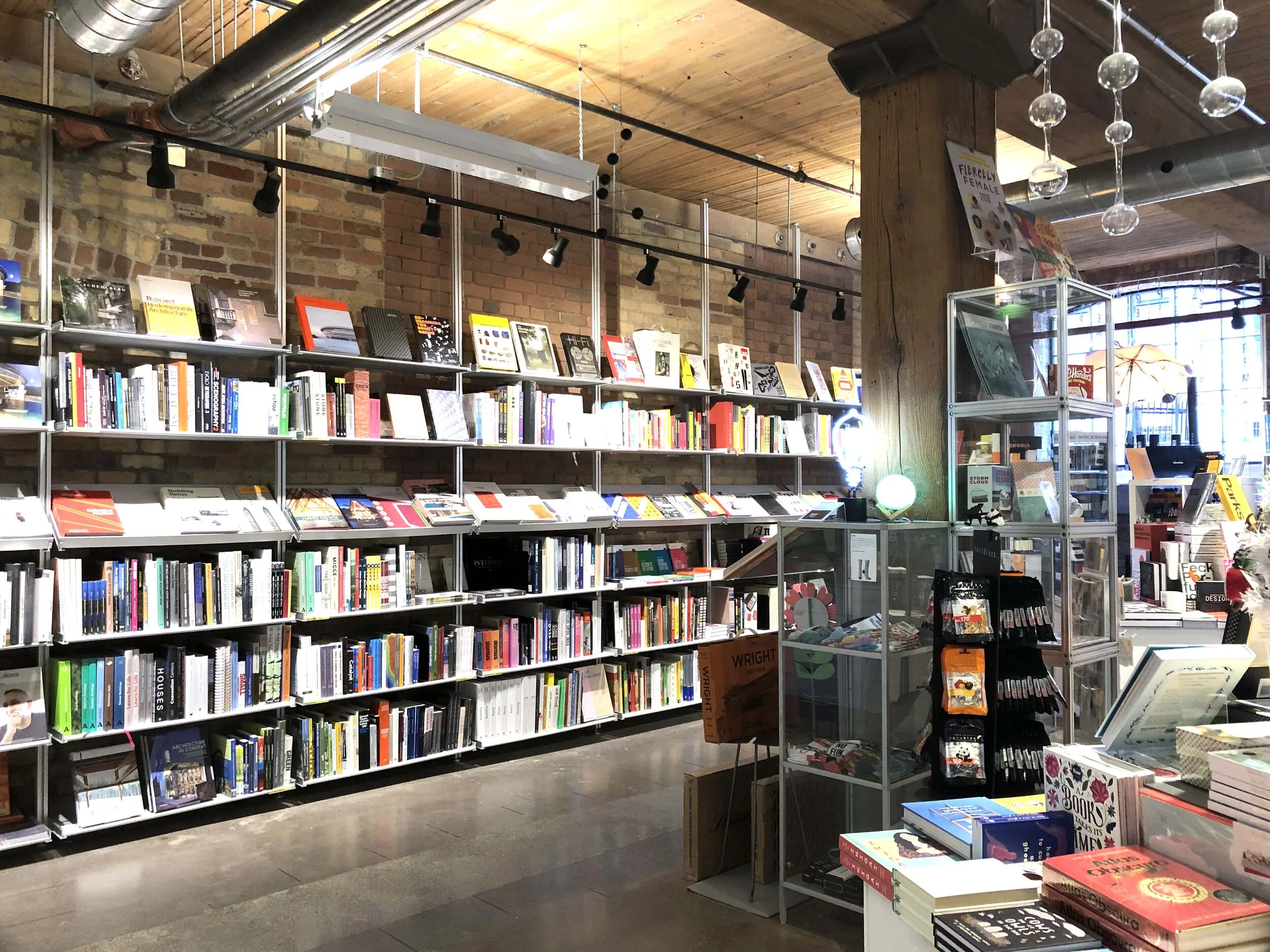
Swipe Books on Advertising and Design is located at 401 Richmond Street West, at Spadina, a truly landmark building in the heart of Toronto’s design district. Much larger than our previous premises, our current store boasts room enough for every graphic design and advertising book worthy of shelf space and a thoughtful selection of well-designed product. Canada's only advertising and design bookstore, Swipe Books is also the official bookstore of the RGD (Registered Graphic Designers of Ontario) and the ADCC (Advertising and Design Club of Canada).
Swipe is open weekdays 10am to 7pm, Saturday 11am to 6pm, closed Sunday.
Swipe is pleased to announce the opening of a shop-within-a-shop in our beautiful store at 401 Richmond Street West. BUILT Books on Architecture will offer the city's largest selection of books and journals on architecture and urban issues, from theoretical and technical reference works to beautiful monographs on today's leading local and international practices. BUILT is hoped, in the fullness of time, to fill the void left by the recent closure of the venerable Ballenford Books.